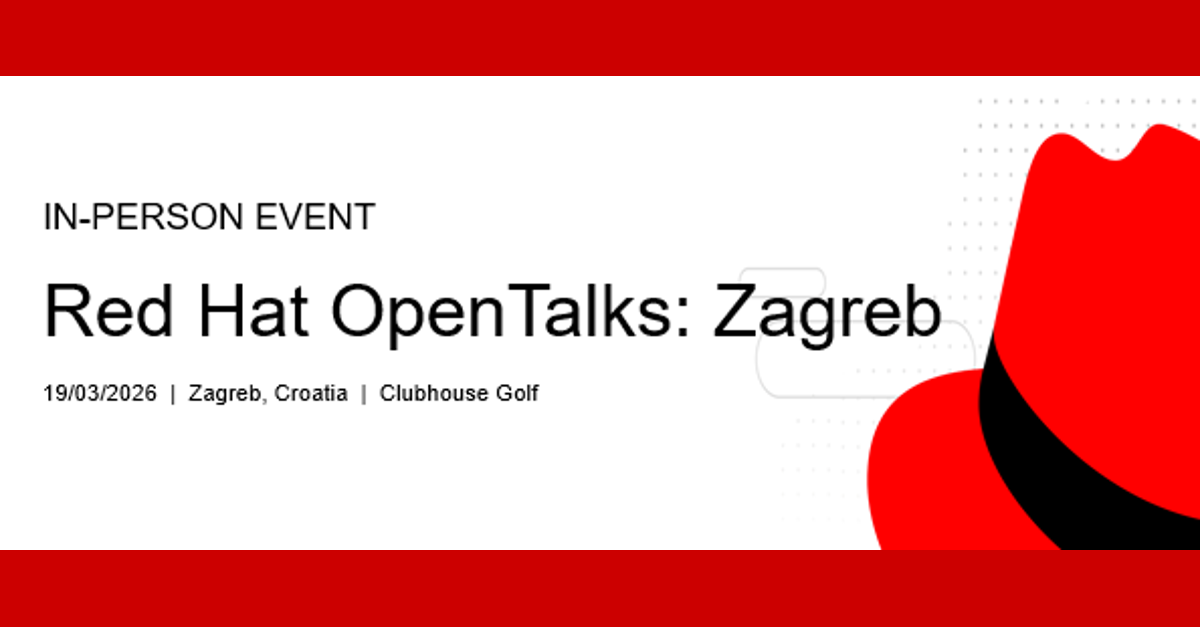
Today I attended Red Hat OpenTalks in Zagreb — a one-day gathering of Red Hat experts and implementation partners — and I’d like to share a few key takeaways.
Going in, most participants (myself included) expected the usual focus on Ansible automation and OpenShift. While those topics were certainly present, the spotlight was clearly on the Red Hat Hybrid Application Platform.
The message was simple, but powerful:
give customers the freedom to choose both the architecture and the deployment target — whether that’s:
* on-premises (VMs or bare metal)
* private cloud
* public cloud
This approach enables true flexibility — avoiding vendor lock-in, ensuring full data sovereignty, improving transparency in security (no hidden backdoors), and giving organizations better control over costs and performance compared to typical cloud-only strategies.
The second major topic, unsurprisingly, was AI.
What stood out was a refreshingly realistic perspective.
Today, it’s widely acknowledged that — apart from Nvidia — most companies are still losing money on AI. This doesn’t only apply to AI vendors like OpenAI or Anthropic, but also to companies consuming AI solutions.
Driven by strong media hype, many organizations rushed into GenAI pilot projects without clearly defined use cases — often trying to fit problems to AI, rather than the other way around. The result?
Significantly increased operational costs and growing doubts about ROI.
That said, there are clear wins in areas like software development, automation, and a few other targeted use cases.
Because of this, Red Hat is focusing on solving the challenges enterprises are actually facing:
*Cost** — still prohibitive at scale for many real-world use cases
*Complexity** — integrating AI into existing systems is far from trivial
*Control** — increasing concerns around data privacy, security, and latency are pushing organizations toward hybrid strategies
Another interesting piece was Debezium CDC (Change Data Capture), which has evolved beyond its earlier Kafka dependency and is now available as both a standalone and embedded component — enabling real-time data integration in a much more flexible way.
Combined with several real-world OpenShift implementation stories from partners, there was more than enough practical insight for everyone in the room.
And that’s perhaps the biggest value of events like this:
when open-source technologies are the focus, you don’t just hear the polished success stories — you also get honest, hands-on experiences that commercial and cloud vendors often leave out.
Comments